Moving a production line by truck: how to plan it

To move a production line by truck, list every piece with its weight, size and lifting points. Group the pieces into trucks, and load them so they arrive in the order the installers need. Plan the lifting at both sites. Declare the value before loading, because the CMR limit is often far below what a machine is worth. RNJ Transport, a road freight and forwarding company in Klaipėda, plans such moves this way.
- A production line move starts with a piece list: every machine, part and crate with a number, weight, size, lifting points and value.
- A standard curtainsider trailer is about 13.6 m long, 2.45 m wide and 2.7 m high inside, with about 24 tonnes of payload.
- Under Directive 96/53/EC, a truck in the EU may be at most 2.55 m wide and 4 m high. Larger loads need special trailers and permits.
- Under the CMR Convention, the carrier’s liability is limited to 8.33 SDR per kg of gross weight, about 10 EUR per kg, unless a higher value is declared in the consignment note.
- Moving your own machines to a site in another EU country can count as a transfer of own goods for VAT (Directive 2006/112/EC, Article 17). Ask your accountant.
Who does what in a production line move
A production line move has three jobs: taking the machines apart, lifting them, and moving them. Your own maintenance team, the machine maker or a rigging company takes the machines apart and lifts them. A forwarder plans and books the trucks. One plan connects the three, so each truck arrives when its pieces are ready.
RNJ Transport plans and books the trucks. We do not take machines apart or lift them. We work with your team or your rigging company on the loading times, the trailer for each piece and the order of the trucks. You get one contact person for all the trucks and one invoice.
- Your company: the piece list, the values, the dates and the contacts at both sites
- Maintenance team, machine maker or rigging company: taking apart, lifting, packing and putting the line back together
- Forwarder: trailers, trucks, loading times, documents and the order of arrival
- Customs broker: declarations, only when the line leaves or enters the EU, or goes to or from Norway
- Insurer: cargo insurance for the value above the CMR limit, if you want it
The piece list: every machine, part and crate
The piece list is the base of the whole move. Give each piece a number and write that number on the piece itself. For each piece, list its weight, its length, width and height, its lifting points, its packing and its value. The forwarder plans the trailers from this list, and the installers use it to check that every piece arrived.
Plan
A production line move in five steps
From the piece list at the old site to the last truck at the new one.
-
Piece list
Every piece with a number, weight, size, lifting points and value.
-
Trucks
Pieces grouped into trucks, with a trailer type for each truck.
-
Preparation
Fluids drained, moving parts locked, pieces wrapped and marked.
-
Loading
One loading list per truck, loaded in the agreed order.
-
Delivery
Trucks arrive in the order the installers need.
Take photos of each machine before it is taken apart, with cables and connections marked. Put the piece numbers on the photos. At the new site, the installers can then match every part to its place. The template at the end of this guide is a piece list you can copy.
Sort the list in the order the installers will put the line back together. The pieces needed first at the new site go on the first trucks. Heavy base frames and machines that others connect to usually come first. Control cabinets, cables and spare parts often come last.
Trailers and size limits
Most pieces of a production line travel on a standard curtainsider trailer. It is about 13.6 m long, about 2.45 m wide and about 2.7 m high inside, with about 24 tonnes of payload. It loads from the side and the back. Many curtainsiders can also open the roof, so a crane can lift a machine in from above.
Sizes
What fits inside a standard curtainsider
About these inside sizes and payload. Larger pieces need a special trailer.
2.45 m
inside width, about
2.7 m
inside height, about
24 t
payload, about
EU limits for the whole truck: 2.55 m wide and 4 m high (Directive 96/53/EC).
A piece higher than about 2.7 m or wider than about 2.45 m does not fit inside a standard curtainsider. It needs a special trailer, such as a low-loader or a flat trailer. Under Directive 96/53/EC, a truck in the EU may be at most 2.55 m wide and 4 m high, and a five-axle truck may weigh at most 40 tonnes in international traffic. A load above these limits needs special permits and sometimes an escort.
Special trailers are possible with partner carriers, on request. Send the exact sizes and weights of these pieces first. Permits for oversize loads take time, so they set the date of the whole move.
| Piece | Trailer | How it loads | What to watch |
|---|---|---|---|
| Machine on a skid, up to about 2.7 m high | Standard curtainsider | Forklift from the side, or crane through the open roof | Weight, centre of gravity, lifting points |
| Machine taller than about 2.7 m | Low-loader or flat trailer, with a partner carrier | Crane or ramp | Total height of truck and load, at most 4 m without a permit |
| Piece wider than 2.55 m | Special trailer with a partner carrier | Crane, planned for each piece | Special permits, sometimes an escort |
| Conveyors, frames, platforms | Standard curtainsider | Forklift, in sections | Length of each section, stackable or not |
| Control cabinets and electronics | Standard curtainsider, kept upright | Forklift or pallet truck | Upright, dry, shock indicators |
| Spare parts, tools, cables | Standard curtainsider | Pallets or crates by forklift | Each crate marked with its piece numbers |
Preparing machines for the road
Prepare each machine as its maker says. Drain oils, coolants and fuels, or follow the maker’s instructions for what may stay inside. Lock every moving part with transport locks, so nothing moves on the road. Wrap open electrical parts and sensitive surfaces against dust and moisture.
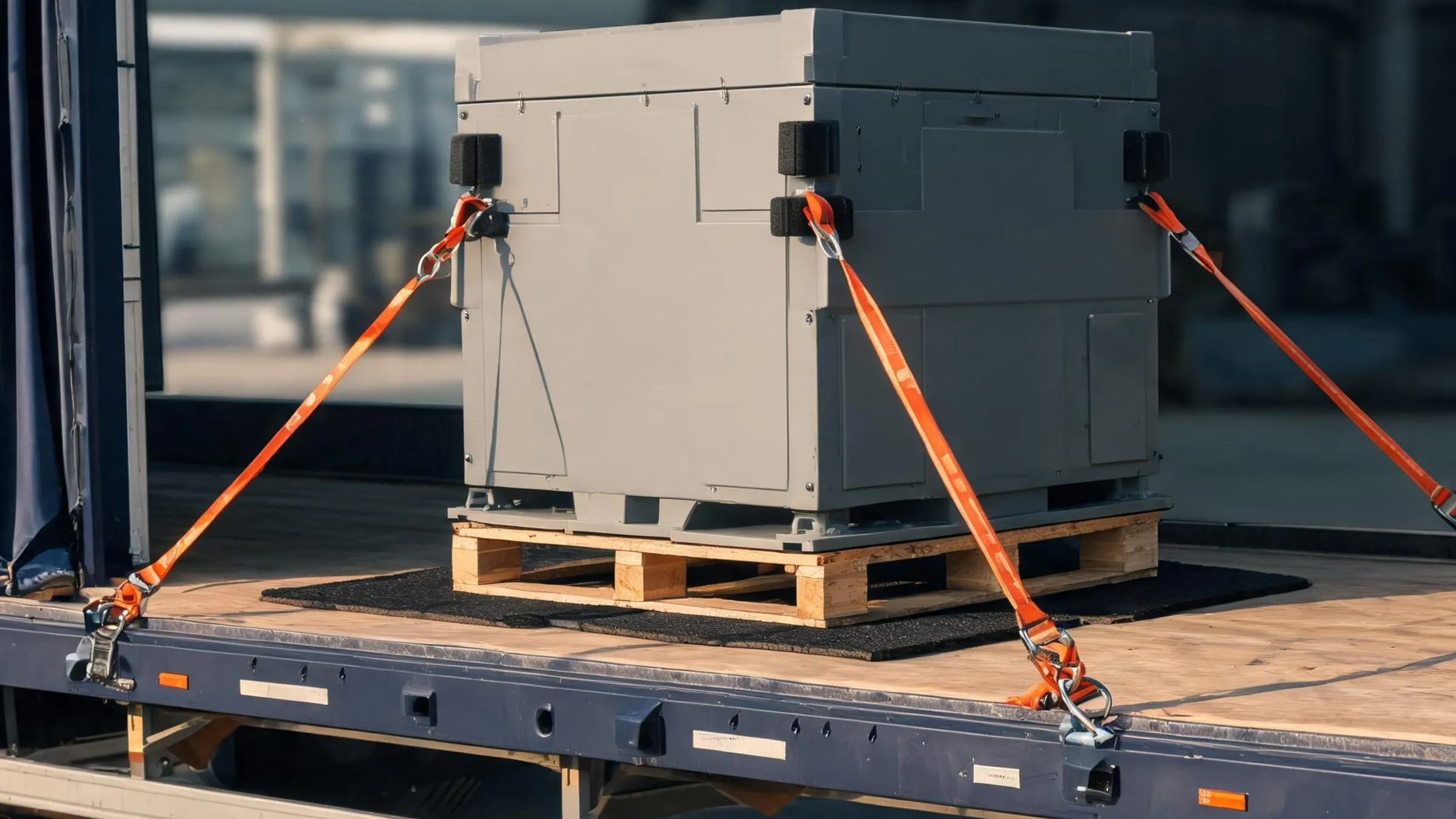
Mark the lifting points and the centre of gravity on each machine. Put heavy machines on skids, so a forklift can lift them. A machine on a skid or in a crate needs straps or chains, and anti-slip mats under it. Agree before loading who places them. The European Commission’s cargo securing guidelines describe the methods.
Fuel residues, batteries and some fluids can make a piece a dangerous good under ADR. RNJ Transport does not carry ADR loads. Tell us before booking if any fuel, batteries or chemicals remain in a machine, so we can tell you whether we can take the piece.
- Fluids drained or handled as the machine maker says
- Moving parts locked with transport locks
- Open electrical parts and surfaces wrapped against dust and moisture
- Lifting points and centre of gravity marked
- Heavy machines on skids, crates marked with arrows that show which way is up
- Piece number on every machine, crate and pallet
Loading days and the order of the trucks
Plan the loading days with the team that takes the line apart. Each truck needs a loading time when its pieces are ready and the forklift or crane is free. A truck that waits for pieces that are not ready costs waiting time. Book fewer trucks per day rather than trucks that wait.
Make one loading list per truck from the piece list. The driver and your team check the pieces against it at loading, and the receiver checks them at delivery. Write the number of pieces and the weight in the CMR consignment note for each truck.
At the new site, the trucks arrive in the order the installers need. Book the crane or the forklift for each delivery, and tell us the opening hours of the site. If a truck’s arrival time changes, we tell you early, so you can move the installers or the crane.
Value, CMR liability and insurance
Under the CMR Convention, the carrier is liable for loss or damage between pickup and delivery, up to 8.33 SDR per kg of gross weight, about 10 EUR per kg. For machines, this limit is often far below their value. Here is an illustration with example numbers. A machine weighs 6,000 kg and is worth 400,000 EUR. Its CMR limit is at most about 60,000 EUR.
The CMR Convention allows two ways to raise the limit. The sender can declare a higher value of the goods in the consignment note (Article 24), or a special interest in delivery (Article 26), against an extra charge agreed with the carrier. Many companies insure the value above the limit with cargo insurance instead. Ask your insurer which suits your move.
Tell us the value of each piece when you book, so we can talk about cover before the first truck leaves. Our guide on CMR liability and cargo insurance explains the limit and the exceptions.
Documents, customs and VAT
Every international truck travels with a CMR consignment note. A production line that moves between EU countries needs no customs declarations. A line that leaves or enters the EU, or goes to or from Norway, needs customs declarations. Tell us who makes them before loading. If you have no customs broker, our partner broker can make the declarations.
Moving your own machines to your own site in another EU country can count as a transfer of own goods for VAT, under Article 17 of the VAT Directive (2006/112/EC). It can then need a VAT number in the country of arrival and a report in both countries. Ask your accountant before the first truck leaves.
| Document | When | Who prepares it |
|---|---|---|
| Piece list and loading list per truck | Every move | Your company, with the rigging team |
| CMR consignment note | Every international truck | Sender and carrier, checked against the loading list |
| Customs declarations | Outside the EU, or to and from Norway | Your customs broker, or our partner broker |
| Permits for oversize loads | Pieces above the EU size or weight limits | The partner carrier with the special trailer |
| VAT records for moving own goods | Own machines to your own site in another EU country | Your accountant |
Piece list for a production line move
Copy the table and add one row for every machine, part, crate and pallet. Send it to your forwarder and your rigging team, and give the same file to the installers at the new site.
| Column | What to write | Example |
|---|---|---|
| Piece number | The number written on the piece | 07 |
| Description | What the piece is | Press, base frame |
| Weight | Gross weight in kg | 6,000 kg |
| Length, width, height | Outside sizes in cm, with the packing | 420 × 210 × 245 cm |
| Lifting | Lifting points and loading method: forklift, crane or ramp | Crane, 4 lifting eyes |
| Packing | Skid, crate, pallet or none; stackable or not | Skid, not stackable |
| Preparation | Fluids drained, transport locks fitted, wrapped | Drained, locked, wrapped |
| Value | Value of the piece in EUR | 400,000 EUR |
| Install order | The order the installers need it at the new site | 1 |
| Truck | The truck the piece travels on | Truck 1 |
Frequently asked questions
-
How many trucks does a production line need?
It depends on the size and the weight of the pieces. Add up the floor space each piece takes and the total weight. Pieces that cannot be stacked use all the floor under them. A standard curtainsider takes about 24 tonnes and 13.6 m of floor. Send us the piece list, and we group the pieces into trucks.
-
Does RNJ Transport take machines apart or lift them?
No. Your maintenance team, the machine maker or a rigging company takes the machines apart and lifts them. RNJ Transport plans and books the trucks. We agree the loading times and the order of the trucks with that team, and we follow every truck to the new site.
-
Can all the trucks load on one day?
Only if all the pieces are ready and the forklift or crane can load them. Trucks that wait for pieces cost waiting time. Most moves load over several days, in the order the pieces come off the line. Plan the loading days with the team that takes the line apart, then book the trucks.
-
Do we need customs to move a line from Germany to Lithuania?
No. Goods that move between EU countries need no customs declarations. Each truck travels with a CMR consignment note and your loading list. Moving your own machines to your own site in another EU country can still count as a transfer of own goods for VAT. Ask your accountant.
-
What if a machine is too large for a normal trailer?
It needs a special trailer, such as a low-loader. Special trailers are possible with partner carriers, on request. A load wider than 2.55 m or a truck higher than 4 m needs special permits. Send the exact sizes and weight of these pieces first, because the permits set the date of the move.
-
Can RNJ Transport handle our production line move?
Yes, the trucks, on our main routes: the Netherlands and Belgium to Lithuania and Latvia, Lithuania with Sweden and Norway, and Germany with the Baltic states. Our own 2 MAN TGX trucks with curtainsider trailers mostly run between Lithuania and Sweden, and we check every partner carrier before every load. Send us the piece list with the addresses and the dates.
Sources (4)
- Council Directive 96/53/EC of 25 July 1996, consolidated text of 14 August 2019
- Convention on the Contract for the International Carriage of Goods by Road (CMR), Geneva, 19 May 1956
- Council Directive 2006/112/EC of 28 November 2006 on the common system of value added tax, Article 17
- European Commission, Directorate-General for Mobility and Transport: Cargo securing for road transport. 2014 European best practices guidelines
We checked these sources on 29 November 2026.
Send us your piece list
Email us the piece list with both addresses and the dates. Use the request form or write to info@rnjtransport.lt. You can also call us during working hours.
+370 698 38573A person in our Klaipėda office answers your call.
Mon–Fri 08:00–17:00, Lithuanian time
Transport request
Send us an email. Please include these details:
- Loading and unloading place
- Cargo: type, pallets or loading metres, weight
- Loading date
- Company name
- Your phone number