Deliveries to a construction site: truck schedule and unloading

RNJ Transport plans full truckloads to construction sites from Klaipėda. For several trucks to one site, set the order of arrival by the assembly sequence and book an unloading slot for each truck. Check that a 16.5 m articulated truck can reach the unloading place. One contact person follows every truck and calls the site before a slot is missed.
- Under EU Directive 96/53/EC, a tractor with a semi-trailer may be up to 16.5 m long, 2.55 m wide and 4 m high, and weigh up to 40 tonnes in international traffic.
- The same directive requires every truck to turn within a ring with an outer radius of 12.5 m and an inner radius of 5.3 m. If the truck must turn on site, plan a free area at least 25 m across.
- A standard curtainsider trailer has no crane. The site unloads it from the side with a forklift or telehandler, or from above with a crane when the roof opens.
- Under CMR Article 30, the receiver notes visible damage or missing packages on the CMR note at delivery. Hidden damage needs a written reservation within 7 days, not counting Sundays and public holidays.
- A vehicle above the EU limits needs a special permit from the road authorities (Article 4(3) of the directive). Tell us about long or heavy pieces before booking.
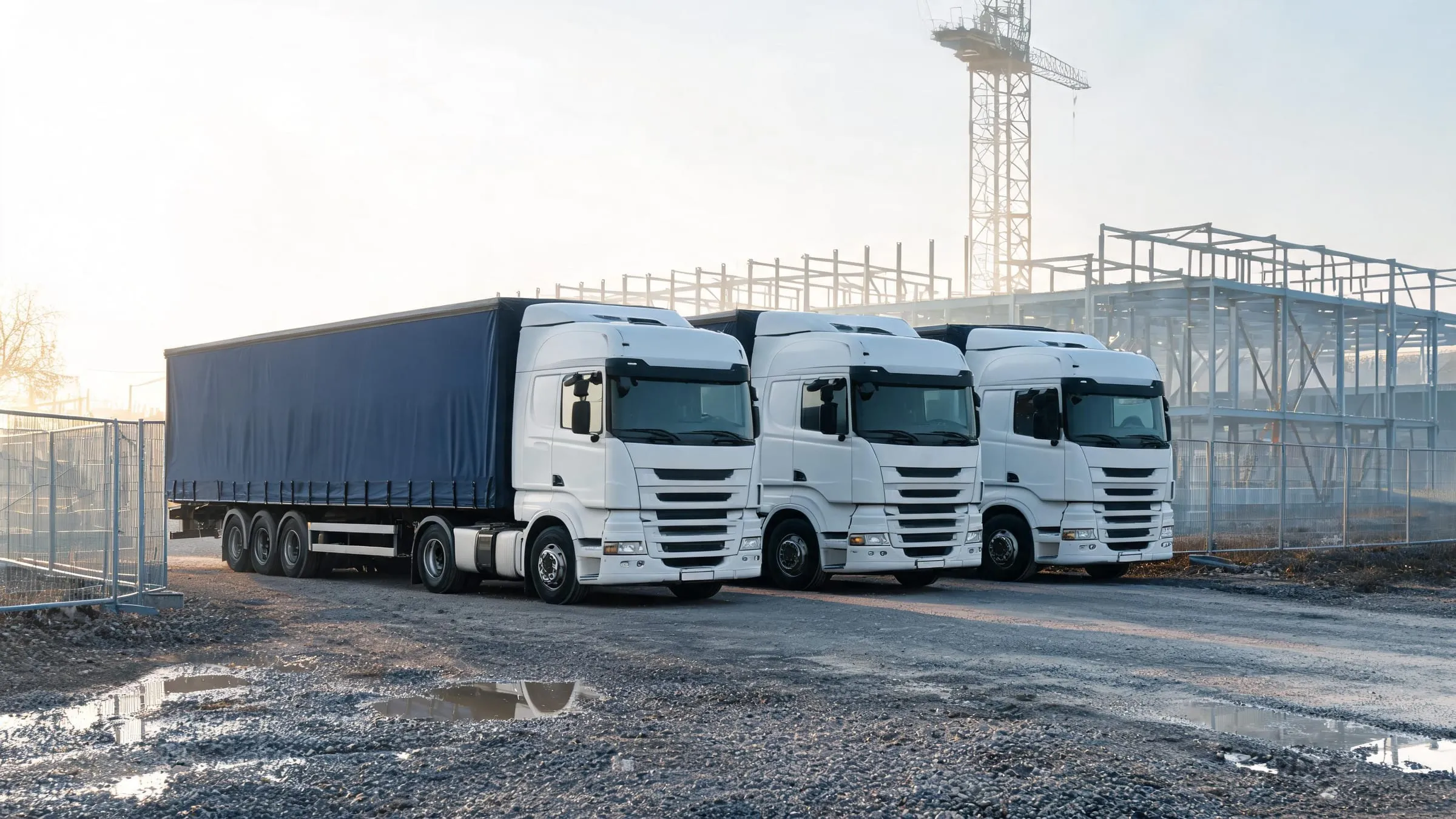
Order of arrival and the assembly sequence
The order of arrival follows the order in which the site builds. The first truck brings what the crew installs first. Each later truck brings the next stage. A site usually has little storage space, so a truck should bring only what the crew uses next. Plan the trucks backwards from the assembly sequence.
Illustration
Four trucks in the order the site builds
A solar park as an example: frames first, then modules, then inverters and cable drums. One unloading slot per truck.
-
Day 1, 08:00–10:00
Truck 1: mounting frames and rails
-
Day 1, 11:00–13:00
Truck 2: solar modules on pallets
-
Day 2, 08:00–10:00
Truck 3: solar modules on pallets
-
Day 2, 11:00–13:00
Truck 4: inverters and cable drums
Illustration, not a real project. Your assembly sequence sets the order, and your site plan sets the slots.
As an illustration, take a solar park. The crew mounts the frames first, then fixes the modules on them, then connects the inverters and cables. So the frames arrive first, the module pallets follow, and the inverters and cable drums come last. The figure shows this order with one unloading slot per truck.
Before the first truck, agree each item in the table with the right party. With these answers, we set a loading date for each truck so it can reach its slot.
| Item | Agree with | Why it matters |
|---|---|---|
| Goods on each truck | The supplier | Each truck brings one stage of the work, in the order the site needs it. |
| Date the goods are ready | The supplier | We set the loading date from it, so the truck can reach its slot. |
| Opening hours of the loading place | The supplier | The truck can load only while the warehouse is open. |
| Unloading slot for each truck | The site and us | Each driver gets the slot time before the truck leaves. |
| Truck and trailer plates, driver phone | Us | The gate and the site contact know which truck is coming. |
| Unloading machine and operator | The site | A standard curtainsider has no crane of its own. |
| Person who signs the CMR note | The site and the buyer | The signature shows when the goods arrived and in what condition. |
Unloading slots and site working hours
An unloading slot is the time window in which the site unloads one truck. Book one slot per truck, inside the site’s working hours, with time for the unloading itself. Leave a gap between two trucks if the site has one machine. Tell us each slot when you book, so every driver knows it before the truck leaves.
Check the calendar on the route as well as on the site. Many sites close on weekends and public holidays. In Germany, trucks over 7.5 tonnes may not drive on Sundays and public holidays from 00:00 to 22:00 (StVO §30). For a Monday morning slot in Germany, the truck can drive again from 22:00 on Sunday.
RNJ Transport follows every truck on the road. Our own 2 MAN TGX trucks run full loads mostly between Lithuania and Sweden, and checked partner carriers drive the other routes. When a truck is late, we call the site contact before the slot and agree a new time or a new order of trucks. You hear about the change from one contact person.
Site access for an articulated truck
Under EU rules, an articulated truck (a tractor with a semi-trailer) may be up to 16.5 m long, 2.55 m wide and 4 m high. The road to the gate, the gate and the unloading place must fit these sizes. The ground must carry up to 40 tonnes. The truck also needs room to turn or a way through.
The same directive requires every truck to turn within a ring with an outer radius of 12.5 m and an inner radius of 5.3 m. If the truck must turn on site, plan a free area at least 25 m across. If there is no such area, plan a route where the truck drives in and out forwards.
Check the last kilometres to the gate as well. Local roads can have lower weight limits, marked with road signs. In Sweden, a private road has no official weight class, and its owner decides the limit. In spring, roads with little traffic can get temporary weight limits while the ground thaws. Ask the site which road the trucks should use.
Some pieces do not fit a standard truck. A standard curtainsider has about 13.6 m of floor. Longer, wider or heavier pieces need a special trailer. A vehicle above the EU limits also needs a special permit from the road authorities (Article 4(3) of the directive). Tell us the size and weight of the largest piece before booking, and we tell you whether a standard truck fits.
| Check | What to look for |
|---|---|
| Road to the gate | A firm surface for up to 40 tonnes. No road sign with a lower weight limit. |
| Gate | Wide enough for a 2.55 m truck to drive in on a turn. Open at the slot time. |
| Free height | More than 4 m under gates, cables, branches and scaffolding on the way in. |
| Turning | A free area at least 25 m across, or a route to drive in and out forwards. |
| Unloading place | Firm and level, close to where the goods are used, with room for the machine along the 13.6 m side of the trailer. |
| Machine | A forklift, telehandler or crane that can lift the heaviest piece, with an operator at the slot time. |
| Waiting place | A place away from the public road where an early truck can wait. |
| Contact on site | One person who answers the phone and can sign the CMR note. |
Unloading equipment and the curtainsider
The site provides the unloading machine. A standard curtainsider trailer has no crane. The curtain opens along the whole side, and a forklift or telehandler unloads from there. When a crane lifts the goods from above, the trailer needs an opening roof. Tell us at booking which machine unloads, so we book a trailer that fits.
Agree in writing who unloads. As a general rule under CMR Article 17(4)(c), the carrier is not liable for damage caused by unloading done by the consignee or by people acting for the consignee. Check your contract with the buyer as well. A truck with its own crane is possible with partner carriers, on request.
Ask the supplier to load each truck in the order the site unloads it. When a crane lifts from above, the pieces needed first should be on top. Our load securing guide explains how the goods stay in place on the trip.
Site details for the forwarder
We need the site details in writing before the first truck loads. Send them once for the whole project, and tell us when something changes. A map pin matters most. Many sites have no street address yet, and the truck gate is often away from the main address. We give every detail to each driver before the truck leaves.
- Site address and a map pin (coordinates) of the truck gate
- Name and phone of the site contact, and a second person if the first is away
- Site working hours and the unloading slot for each truck
- Access rules: the road to use, height and weight limits, and where to wait
- Site rules for drivers, for example a helmet, a safety vest or a sign-in at the gate
- Who unloads, with which machine, and the weight of the heaviest piece
- Documents the site needs, such as the delivery note, the packing list and your order number on the CMR note
CMR signature and remarks at the site
The person who receives the goods on site signs the CMR note for the consignee. Name that person before the first truck, and agree with the buyer whether a company stamp is needed. Before signing, count the packages and look at the goods with the driver. Write any missing or damaged package on the note, then sign.
Under CMR Article 30, a signature without remarks lets the law presume that the goods arrived as the note describes them. Visible damage must be noted at delivery. Damage you cannot see needs a written reservation to the carrier within 7 days, not counting Sundays and public holidays. Our guides to the CMR consignment note and to CMR insurance explain the fields and the deadlines.
Write short, plain remarks, for example “2 pallets missing” or “1 pallet damaged, film torn”. Take photos before the goods move. Send us the photos and the signed note the same day. With RNJ Transport, you get a copy of the signed CMR after each delivery.
Delivery schedule template
The template has one row per truck. Fill it in with the supplier and the site, then send it to us with the booking. We add the plate numbers and the driver phone for each truck before loading. The rows below are an illustration for a solar park, not a real project.
| Truck | Contents | Loading place and date | Unloading slot | Unloading equipment | Contact on site |
|---|---|---|---|---|---|
| Truck 1 | Mounting frames and rails, in bundles | Frame supplier, date agreed with us | Day 1, 08:00–10:00 | Forklift from the side | Site manager: name and phone |
| Truck 2 | Solar modules on pallets | Module warehouse, date agreed with us | Day 1, 11:00–13:00 | Telehandler from the side | Site manager: name and phone |
| Truck 3 | Solar modules on pallets | Module warehouse, date agreed with us | Day 2, 08:00–10:00 | Telehandler from the side | Site manager: name and phone |
| Truck 4 | Inverters and cable drums | Electrical supplier, date agreed with us | Day 2, 11:00–13:00 | Crane from above, trailer with an opening roof | Electrical foreman: name and phone |
Frequently asked questions
-
How long is an articulated truck?
Up to 16.5 metres under EU rules. EU Directive 96/53/EC sets this limit for a tractor with a semi-trailer. The same directive limits the width to 2.55 metres and the height to 4 metres. The floor of a standard curtainsider trailer is about 13.6 metres long. Check that the road, the gate and the unloading place fit a truck of this size.
-
How much space does a truck need to turn on a construction site?
Plan a free area at least 25 metres across. EU rules require every truck to turn within a ring with an outer radius of 12.5 metres and an inner radius of 5.3 metres. Keep the area free of stored goods, cabins and machines at the slot times. If there is no such area, plan a route where the truck drives in and out forwards.
-
Who unloads the truck at a construction site?
Usually the site, with its own forklift, telehandler or crane. A standard curtainsider trailer has no crane. As a general rule under CMR Article 17(4)(c), the carrier is not liable for damage caused by unloading done by the consignee. Agree in writing who unloads, and tell us which machine the site uses. A truck with its own crane is possible with partner carriers, on request.
-
Who signs the CMR note at the site?
The person who receives the goods for the consignee. Usually this is the site manager or a storekeeper named by the buyer. Name this person before the first truck, and add a second person for days when the first is away. The signature, date and time on the note show when the goods arrived. With RNJ Transport, you get a copy of the signed CMR after each delivery.
-
What should I write on the CMR if goods arrive damaged?
Write what you see, before you sign. For example, “1 pallet damaged, film torn” or “2 pallets missing”. Under CMR Article 30, visible damage must be noted at delivery. Damage you find later needs a written reservation within 7 days, not counting Sundays and public holidays. Take photos and send them to us with the signed note.
-
When should I send the delivery schedule?
As soon as the site schedule is fixed. With more notice, trucks for fixed dates are easier to find, and each loading date is easier to plan. Send the schedule even if some slots may still change. We update the plan with you, and every driver gets the final slot time before the truck leaves.
Sources (5)
- Council Directive 96/53/EC of 25 July 1996, consolidated text of 14 August 2019
- Convention on the Contract for the International Carriage of Goods by Road (CMR), Geneva, 19 May 1956. United Nations Treaty Series, Volume 399
- Straßenverkehrs-Ordnung (StVO), § 30 Umweltschutz, Sonn- und Feiertagsfahrverbot
- Transportstyrelsen, Bärighetsklasser
- Regeringskansliet, Svar på fråga 2025/26:705 om tjälnedsättningar på statliga vägar, 21 april 2026
We checked these sources on 24 October 2026.
Plan the trucks for your site
Send a request with the site, the dates and the number of trucks, or call us during working hours. One contact person plans every truck with you.
+370 698 38573A person in our Klaipėda office answers your call.
Mon–Fri 08:00–17:00, Lithuanian time
Transport request
Send us an email. Please include these details:
- Loading and unloading place
- Cargo: type, pallets or loading metres, weight
- Loading date
- Company name
- Your phone number