Export declaration for road freight leaving the EU: who files it and when

RNJ Transport arranges full truckloads from Lithuania to Norway and other countries outside the EU, and our partner customs broker can prepare the export declaration. EU goods that leave the EU customs territory need one. The exporter or its customs representative files it electronically before the truck leaves. Customs then certifies the exit, the usual proof of export for VAT.
- EU goods that leave the EU customs territory are placed under the export procedure. The export declaration goes electronically into AES, the EU Automated Export System.
- For road transport, the export declaration is due at the latest one hour before the goods leave the EU customs territory (Article 244 of Delegated Regulation (EU) 2015/2446).
- As a main rule, the declarant must be established in the EU. A customs broker can act in the exporter’s name or in its own name for the exporter (Union Customs Code, Articles 18 and 170).
- The customs office of export certifies the exit to the declarant or the exporter. The EU VAT Directive exempts goods transported outside the EU, and each EU country sets the conditions.
- Transit lets goods travel under customs control to a customs office of destination. Norway, Switzerland and the United Kingdom take part in the common transit procedure with the EU.
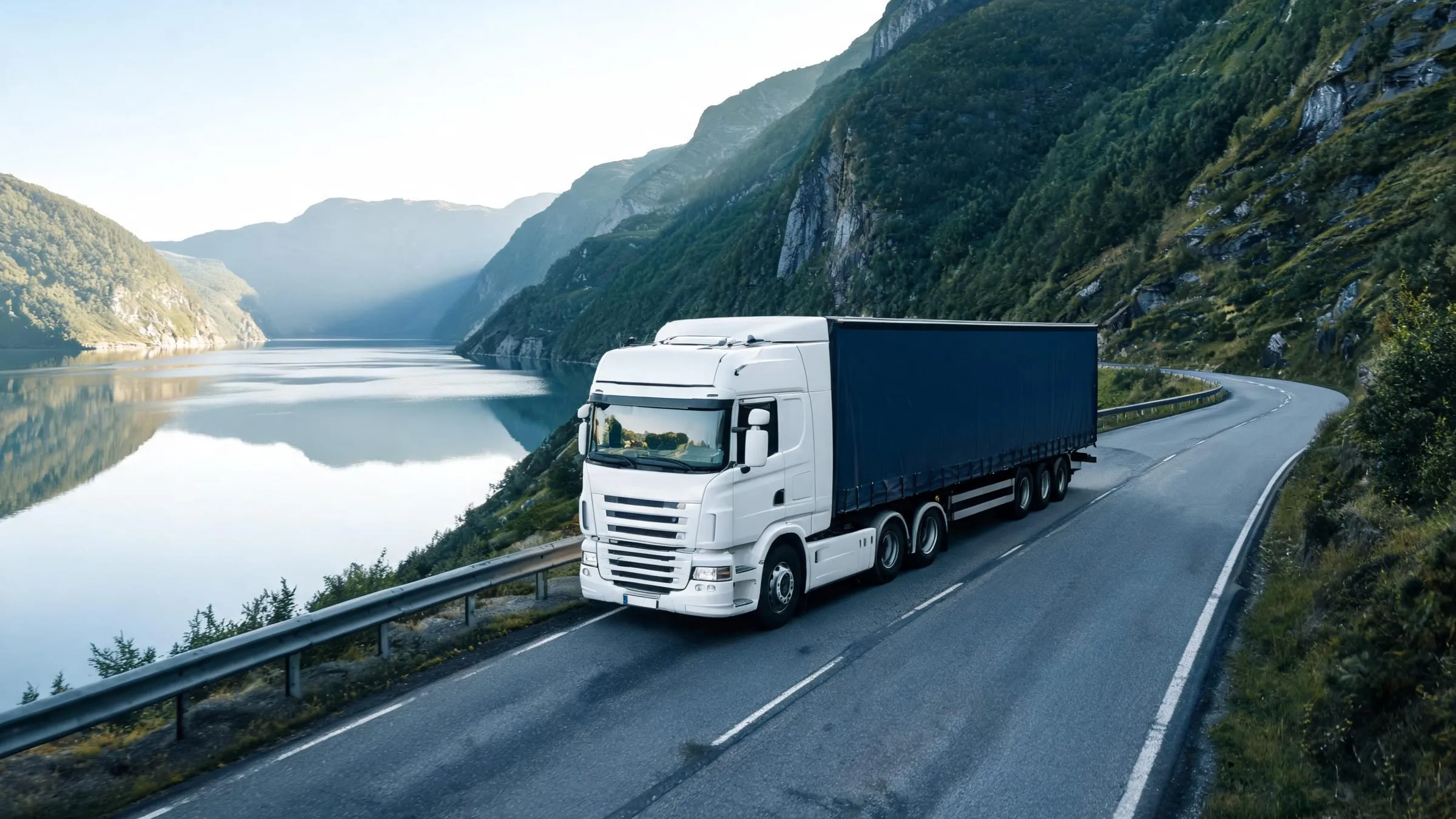
When a truck load needs an export declaration
A truck load needs an export declaration when EU goods leave the EU customs territory, for example for Norway, Switzerland or the United Kingdom. The Union Customs Code places such goods under the export procedure. The European Commission says the procedure applies with few exceptions. Loads between EU countries need no export declaration.
The declaration goes electronically into AES, the EU Automated Export System. The exporter or its representative files it at the customs office where the exporter is established, or where the goods are packed or loaded. Our guide to customs inside the EU explains the documents for loads that stay in the EU.
For road transport, the export declaration also serves as the pre-departure declaration, with the data customs needs for safety checks. It is due at the latest one hour before the goods leave the EU customs territory. Under EU rules, the carrier may load the goods for exit once it has the MRN and the other exit details.
Who does what and when: exporter, customs broker, carrier and buyer
Four parties share the work on an export load: the exporter, its customs broker, the carrier and the buyer. Customs offices at the start and at the EU border complete it. The table follows one load from the sales contract to the exit confirmation. Write one name next to each row in your company.
When you book a load outside the EU with RNJ Transport, our partner customs broker can be the broker in this table. The broker prepares the export declaration and, if you need it, the import declaration. You order the customs papers and the transport together, and you keep one contact person for both.
| When | Who | What happens |
|---|---|---|
| When you agree the sale | Exporter and buyer | The contract names the Incoterms rule. Both agree in writing who makes the export declaration and who makes the import declaration. |
| When the goods are packed | Exporter | Sends the customs broker the invoice, packing list, EORI number, commodity codes, value, origin and weights. |
| Before loading, at the latest one hour before the truck leaves the EU | Customs broker | Lodges the export declaration in AES. Customs registers it under an MRN. |
| Before loading | Exporter or customs broker | Gives the carrier the MRN, the transport document number and the number of packages. |
| At the EU border | Carrier and driver | Present the goods with the MRN at the customs office of exit. With transit, this happens at the transit office of departure. |
| By the next working day after exit | Customs | The office of exit tells the office of export that the goods left. The office of export certifies the exit. |
| After exit | Customs broker and exporter | The broker sends the exit confirmation. Accounting files it with the sales invoice and the signed CMR. |
| At the destination | Buyer or its customs broker | Makes the import declaration under the rules of Norway, the United Kingdom or Switzerland. |
Data and documents for the customs broker
A customs broker can lodge the export declaration only with complete data. The Union Customs Code requires the declarant to be able to give all the information the procedure needs. So the broker asks the exporter for the data before loading. Send it when the goods are packed, so the truck does not wait for the papers.
Economic operators established in the EU register with customs. The EORI number is the registration number, and it is unique in the whole EU customs territory. Check your EORI number with your customs broker before the first export load.
A customs broker can act as your customs representative in two ways. In direct representation, the broker acts in your name and on your behalf. In indirect representation, the broker acts in its own name but on your behalf. Your customs broker confirms which form fits your goods.
As a main rule, the declarant must be established in the EU. In EU customs law, the exporter is also a person established in the EU. When a buyer outside the EU sends its own truck, agree in writing who lodges the export declaration and in whose name.
- The commercial invoice with the seller, the buyer, the description of the goods, the value and the currency.
- The packing list with the number of packages and the gross and net weight.
- The exporter’s EORI number.
- The commodity code of each item.
- The country of origin of the goods.
- The Incoterms rule and the delivery address.
- The truck and trailer numbers. We send them to you before loading.
- Any licence or certificate the goods need for export.
MRN and the exit confirmation
The MRN, the Master Reference Number, is the registration number that customs gives to a declaration. The driver presents the goods with the MRN at the customs office of exit. That office tells the office of export that the goods left, and the office of export certifies the exit to the declarant or the exporter.
Export
From the invoice to the exit confirmation
Five steps for a truck load that leaves the EU, with the time limits from EU customs law.
1 hour
latest filing before exit by road
1 day
exit message by next working day
90 days
before customs may ask about exit
-
Data to the broker
The exporter sends invoice, packing list, EORI number, commodity codes, value, origin and weights.
-
Export declaration
Lodged in AES at the latest one hour before the truck leaves the EU.
-
MRN to the carrier
The carrier gets the MRN and the package count before loading for exit.
-
Office of exit
The driver presents the goods and the MRN at the EU customs office of exit.
-
Exit confirmation
Customs certifies the exit to the declarant or exporter. Accounting files it.
Your customs broker confirms the details for your goods. With transit, the transit office of departure acts as the office of exit.
On a road load, the customs office of exit is usually the office for the place where the goods leave the EU. If the goods travel under transit after export, the office of departure of the transit acts as the office of exit. Where the two offices differ, the office of exit sends its message by the next working day after the goods leave.
The exit confirmation matters for accounting. The EU VAT Directive exempts goods transported outside the EU, and each EU country sets the conditions. Your Europe, the EU portal for businesses, says an exporter must show documents that prove the goods left the EU. The exit confirmation from customs is the usual evidence. This is general information, not tax advice. Ask your accountant which documents your tax office expects.
The office of export may wait for the exit message. After 90 days from the release for export, it may ask the declarant for the date and the office of exit. If the office of exit gives no answer, the declarant can send other evidence. The Implementing Regulation names examples: a delivery note signed by the consignee outside the EU, proof of payment, the invoice, a document from the company that took the goods out, or a document processed by customs in an EU or a non-EU country.
Transit under NCTS: T1 and T2
Transit lets goods travel under customs control from one customs office to another. Import duties and taxes are suspended on the way, and customs clearance takes place at the destination. The transit declaration goes into NCTS, the New Computerised Transit System. A load to or from Norway, Switzerland or the United Kingdom can travel this way.
T1 is used mainly for non-Union goods. An example is a load from Norway to Lithuania that is cleared in Lithuania instead of at the EU border. T2 is used mainly for Union goods, for example export goods that travel to or through a common transit country. Your customs broker chooses the type for your load.
The holder of the transit procedure presents the goods intact at the customs office of destination within the time limit, and provides a guarantee. A carrier that accepts goods knowing that they move under transit is also responsible for presenting them intact. So the driver keeps any customs seals and the documents unchanged until the office of destination.
The common transit procedure links the EU with Iceland, Norway, Liechtenstein, Switzerland, Türkiye, North Macedonia, Serbia, the United Kingdom, Ukraine, Georgia, Moldova and Montenegro. The European Commission says its rules are the same as those of Union transit.
Import in Norway, the United Kingdom and Switzerland
After the goods leave the EU, the customs rules of the destination country apply. In Norway, the United Kingdom and Switzerland, the goods need an import declaration there. Usually the buyer or its customs broker makes it. The Incoterms rule in the sales contract decides who arranges and pays for each declaration, as our Incoterms guide explains.
Norway also requires Digitoll data for every truck that brings goods in. Our blog post on Digitoll gives the dates, the messages and who sends them. Our country pages for the United Kingdom and Switzerland list the documents for those routes.
RNJ Transport arranges full truckloads between Lithuania and Norway with checked partner carriers, and loads to the United Kingdom and Switzerland on request. Our partner customs broker prepares the export and import declarations, ordered together with the transport. You keep one contact person and get one invoice for the transport. We do not transport goods to or from Russia or Belarus.
Document checklist before an export load leaves
Use this list for each load to Norway, Switzerland, the United Kingdom or another country outside the EU. Write who in your company prepares each item. Your customs broker confirms the details for your goods.
| Document or data | Who prepares it | Ready by |
|---|---|---|
| Sales contract with the Incoterms rule | Exporter and buyer | Before you book the truck |
| Commercial invoice | Exporter | Before the export declaration |
| Packing list with gross and net weight | Exporter’s warehouse | Before the export declaration |
| EORI number of the exporter | Exporter, registered with customs | Before the first export load |
| Commodity code for each item | Exporter, checked by the customs broker | Before the export declaration |
| Country of origin | Exporter | Before the export declaration |
| Licence or certificate, if the goods need one | Exporter | Before the export declaration |
| Export declaration and its MRN | Customs broker | Before loading, at the latest one hour before the truck leaves the EU |
| Transit declaration (T1 or T2), if used | Customs broker | Before the truck leaves the office of departure |
| CMR consignment note | The sender and the carrier sign it | At loading |
| Import declaration | Buyer or its customs broker | Under the rules of the destination country |
| Exit confirmation | Customs, sent on by the customs broker | After exit. Accounting files it with the sales invoice. |
Frequently asked questions
-
Does a truck load to Norway need an export declaration?
Yes. Norway is outside the EU customs territory, so EU goods that go there are placed under the export procedure. The exporter or its customs broker lodges the export declaration electronically in AES. For road transport, it is due at the latest one hour before the goods leave the EU. The load also needs a Norwegian import declaration and Digitoll data.
-
Who files the export declaration, the seller or the buyer?
Usually the seller, as the exporter, through a customs broker. In EU customs law, the exporter is a person established in the EU. As a main rule, the declarant must be established in the EU too. A customs broker can act in your name or in its own name on your behalf. Agree it in writing with the buyer before loading.
-
What is an MRN on an export declaration?
The Master Reference Number, the registration number that customs gives to the declaration. The person who hands the goods to the carrier gives the carrier the MRN. The carrier may load the goods for exit once it has the MRN and the other exit details. The driver then presents the goods with the MRN at the customs office of exit.
-
Is the exit confirmation proof of export for VAT?
Usually, yes. The EU VAT Directive exempts goods transported outside the EU, and each EU country sets the proof it accepts. The exit confirmation from customs is the usual evidence that the goods left the EU. Keep it with the sales invoice and the signed CMR. Ask your accountant which documents your tax office expects.
-
What if the exit confirmation does not arrive?
The declarant can give other evidence. After 90 days from the release for export, the office of export may ask for the date and the office of exit. If the office of exit gives no answer, the declarant can send other proof. Examples are a delivery note signed by the consignee outside the EU, proof of payment or a customs document from the destination country.
-
When does a load need a T1 transit declaration?
Mainly when non-Union goods travel under customs control inside the EU. An example is a load from Norway that is cleared in Lithuania instead of at the EU border. Union goods that travel to or through a common transit country usually move under T2. The declaration goes into NCTS, and the holder provides a guarantee. Your customs broker chooses the type for your load.
Sources (8)
- Regulation (EU) No 952/2013 of the European Parliament and of the Council laying down the Union Customs Code, Articles 5, 9, 18, 170, 226, 227, 233, 263, 267 and 269
- Commission Delegated Regulation (EU) 2015/2446, consolidated text of 1 July 2026, Article 1(18) and (19) and Article 244
- Commission Implementing Regulation (EU) 2015/2447, consolidated text of 1 July 2026, Articles 221, 329 and 332 to 335
- Exportation, European Commission, Taxation and Customs Union
- What is customs transit, European Commission, Taxation and Customs Union
- Council Directive 2006/112/EC on the common system of value added tax, Articles 131 and 146
- VAT rules and rates, Your Europe (last checked 13 July 2026)
- T1 and T2 transit, Tullverket (last updated 21 August 2025)
We checked these sources on 24 October 2026.
Order customs papers with your transport
Send a request with the route, the goods and the loading date, or call us during working hours. Tell us the destination country, so we can plan the export and import declarations with our partner customs broker.
+370 698 38573A person in our Klaipėda office answers your call.
Mon–Fri 08:00–17:00, Lithuanian time
Transport request
Send us an email. Please include these details:
- Loading and unloading place
- Cargo: type, pallets or loading metres, weight
- Loading date
- Company name
- Your phone number